PBL Assay Science
PBL Assay Science era precedentemente conosciuta come PBL Interferon Source. Il fondatore, Sidney Pestka, ha esplorato per decenni le applicazioni dell'interferone in medicina. Negli ultimi due decenni, PBL Assay Science è cresciuta da start-up a società rispettata, impiegando tecnologie all'avanguardia nella produzione di prodotti per gli scienziati di tutto il mondo. Poiché la nostra ricerca e i nostri prodotti sono andati oltre l'interferone, disponiamo oggi anche di numerosi assay kits per differenti citochine.

Not All IFN-Alpha All-Subtype ELISA kits Are Equal
“All-Subtype” IFN-Alpha Detection:
What the Label Says vs. What the Data Shows
The term “All-Subtype” is appearing on some other IFN-α ELISA kit labels—But the validation behind this claim is limited.
In some cases, validation relies on a natural IFN-α preparation derived from a single cell type under a specific stimulation condition. Such a preparation represents a single snapshot of IFN-α subtype composition. That snapshot may then be used to demonstrate assay performance characteristics such as linearity and parallelism relative to the kit's reference standard, supporting an "all-subtype" claim.
However, a single natural reference is not necessarily representative of the entire IFN-α family. It reflects one biological context, and the subtype profile present in that preparation may differ substantially from the subtype composition present in experimental or clinical samples.
|
Why This Matters
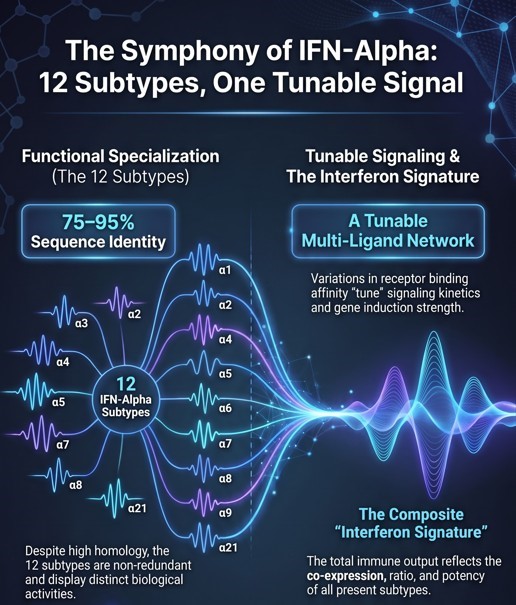
Human IFN-α is a family of 12 distinct subtypes, and their composition is highly context-dependent.
• Different cell types (e.g., plasmacytoid dendritic cells, macrophages, epithelial cells) produce distinct subtype profiles, even in response to the same stimulus
• Biological context—viral infection, autoimmune activation, chronic disease—can shift both:
o Total IFN-α levels
o Subtype distribution
Importantly, not all IFN-α subtypes contribute equally to biological activity. Potent subtypes such as IFN-α14 may elicit strong ISG induction and antiviral responses relative to their abundance. Yet some assays may not have been individually evaluated against every IFN-α subtype.
|
 |
Potential Consequences
When subtype coverage is assumed rather than experimentally demonstrated:
• Low ELISA signals may not always correspond to low IFN-α activity
• Similar reported IFN-α levels can be associated with different biological responses
• Changes in subtype composition may go undetected or be misinterpreted
• Comparisons across samples, treatments, or disease states are only as reliable as the assay's demonstrated subtype coverage
The PBL Difference
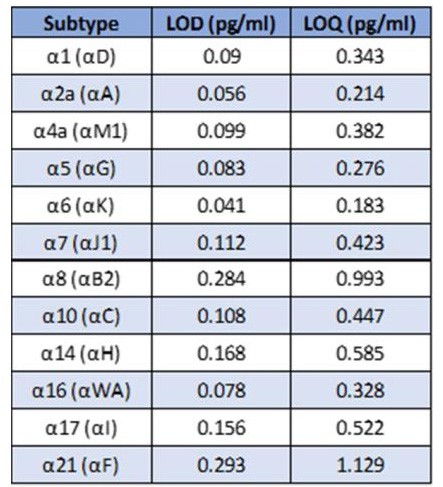
PBL’s VeriKine-HS Human IFN-Alpha “All-Subtype” ELISA kits take the fundamentally different approach. Instead of relying on a “natural IFN-alpha” preparation, each of the 12 IFN-alpha subtypes is tested individually using verified recombinant proteins. This ensures that every subtype is characterized on its own terms, independent of the biological context in which appears.
|
• Trustworthy measurements
— Low signals reflect genuinely low
IFN-α, not undetected subtypes
• Biology that makes sense
— Differences in signaling and activity may be correctly interpreted, including cases of strong responses with modest ELISA readings
• Full inclusion of high-impact subtypes
— Potent contributors such as Alpha 14 may properly measure within a verified range
|
Representative Subtype LLOQs and LLODs in Healthy Human Serum
|
Selected Product Citations:
1. Gentner B et al. (2026), “Tumor-targeted interferon alpha gene therapy for glioblastoma: a phase 1 trial”, Nat Med. DOI: 10.1038/s41591-026-04416-1
2. Kawase M et al., (2025), “Potential for prolonged replication of common acute respiratory viruses in air-liquid interface cultures of primary human airway cells”, mSphere, DOI: 10.1126/msphere.00422-25
3. Lopez J et al., (2024), “Autogene cevumeran with or without atezolizumab in advanced solid tumors: a phase 1 trial”, Nat Med., DOI: 10.1038/s415-1-024-03334-7
4. Suffiotto M et al., (2024)", “Pharmacodynamics of the S1P1 receptor modulator cenerimod in a phase 2b randomized clinical trial in patients with moderate to severe SLE”, Ann Rheum Dis, DOI: 10.1136/ard-2024-226547